
Total: ₹0.00
Taxes and shipping calculated at checkout

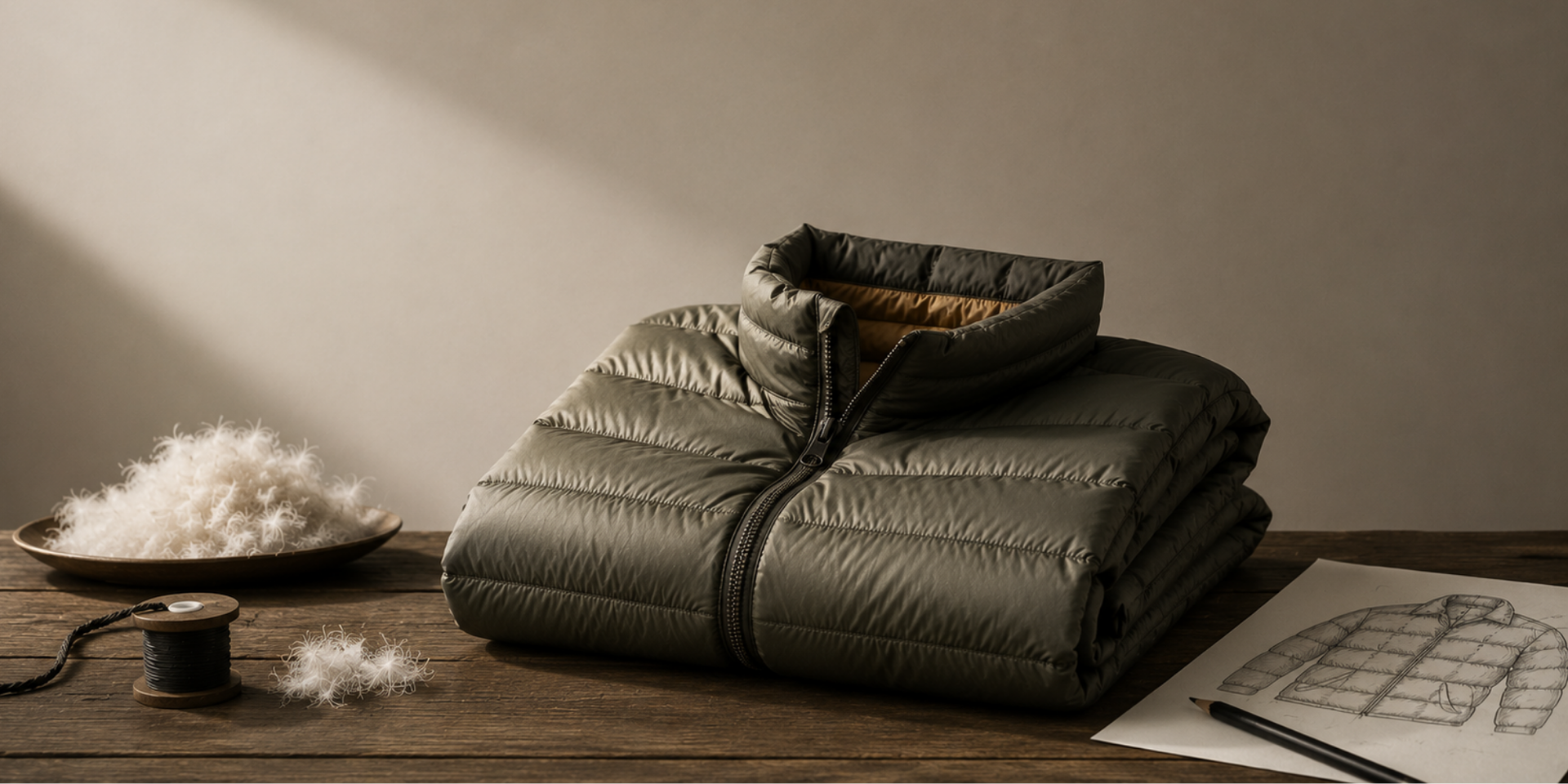
In the early 1930s, a fisherman nearly froze to death in Washington State. What happened next changed the way the world gets dressed.
Picture this.
It is a winter morning somewhere in the Pacific Northwest. The kind of cold that arrives quietly - not with howling wind, but with a slow, creeping certainty. A man is out fishing, as he has been dozens of times before. He knows this terrain. He trusts it.
And then, without warning, the cold wins.
The man nearly dies of hypothermia on that trip. He makes it home, barely. And when he does, he does something that would permanently alter the course of outdoor apparel, fashion, and the way human beings have kept themselves warm ever since.
He invents the down jacket.
The man is Eddie Bauer. The year is sometime in the early 1930s. And the story of what came next is one of the most remarkable - and least told - origin stories in the history of clothing.
To understand how a fishing trip produced the world's most iconic piece of outerwear, you have to go back a little further.
Eddie Bauer opened his sporting goods store in downtown Seattle in 1920, at the age of 21. He was not, at that point, in the business of saving lives. He made tennis rackets. He hand-crafted golf clubs. And in 1934, he patented a badminton shuttlecock that became - and remains - the global standard for the sport.
That last detail matters more than it sounds.
Making shuttlecocks requires an intimate, hands-on understanding of goose down: how it behaves, how it clusters, how it traps air, how it insulates. Eddie spent years working with down as a raw material before it ever occurred to him that it could do something far more important than help a shuttlecock fly straight.
It took a near-death experience to make that connection.
Before 1936, keeping warm in the outdoors meant layering heavy wool. Wool was the standard. It was what soldiers wore, what mountaineers wore, what fishermen wore. It worked - until it got wet. And in the Pacific Northwest, wet was not a possibility. It was a guarantee.
Wool absorbs moisture. Once it is wet, it becomes heavy, loses much of its insulating ability, and takes an age to dry. In mild conditions, this is uncomfortable. In extreme conditions, it is dangerous. It was precisely this failing that nearly killed Eddie on that winter fishing trip - and it was precisely this failing that he set out to eliminate.
He already had the solution in his workshop. He had been working with it for years.
Drawing directly on his knowledge of goose down from the shuttlecock work, Eddie designed and constructed something that had never existed before: a quilted jacket with channels of goose down sewn inside, creating pockets of trapped warm air across the entire body.
The result was extraordinary.
In 1936, he patented America's first quilted down jacket and named it the Skyliner. Compared to anything available at the time, it was a revelation:
Lightweight. A fraction of the weight of wool layers that offered the same warmth.
Wind-resistant. The outer shell blocked the cold at the surface while the down held the heat inside.
Packable. It could be compressed and carried in a way that bulky wool simply could not.
Warm when it mattered. Unlike wool, down retains its insulating properties even in cold, dry conditions.
It was not an incremental improvement on what existed. It was a complete rethinking of how a garment could work.
The outdoor apparel industry had a new benchmark - and it had been set by a man who nearly didn't survive long enough to set it.
Here is the part of the story that rarely gets told.
The down jacket did not emerge from a research and development department. There was no team of engineers, no product brief, no market research. There was one man, working alone, driven entirely by the very personal knowledge of what it feels like when the cold wins.
Had Eddie Bauer not gone on that fishing trip, the Skyliner may never have existed. Had he been less stubborn, less curious, less convinced that the problem could be solved, he might have simply switched to heavier wool and moved on.
Instead, he went home and built something that didn't exist yet.
That is the detail that makes the Eddie Bauer story different from almost every other brand origin story. It was not invented for a market. It was invented for a moment - a specific, urgent, personal moment of survival. And the result of that moment is now worn by millions of people around the world, every single winter, without most of them knowing where it came from.
The Skyliner was the beginning. What followed was a series of moments that proved the invention over and over again, at the highest stakes imaginable.
In 1942, the US Army Air Corps commissioned Eddie Bauer to produce over 50,000 B-9 Flight Parkas for pilots flying at extreme high altitude. The same down technology that kept a fisherman alive on a frozen river was now keeping American pilots alive in the upper atmosphere.
In 1953, Eddie Bauer created the Kara Koram Parka for the American team attempting the first ascent of K2 - the world's second-highest and most treacherous mountain. The team called it "the finest cold-weather, high-altitude equipment I have ever seen."
In 1963, Eddie Bauer outfitted the first American team to successfully summit Mount Everest.
These are not marketing claims. They are field tests conducted at the absolute limits of human endurance, by people whose lives depended on the gear performing exactly as promised. And it did.
Eddie Bauer built his entire brand on one principle: if the product doesn't perform, fix it or replace it.
From the first day his store opened, he offered an unconditional lifetime guarantee. Not a seasonal warranty. Not a terms-and-conditions document. A simple, unbreakable promise - any product that failed to perform could be returned, no questions asked.
"To give you such outstanding quality, value, service and guarantee that we may be worthy of your high esteem." - The Eddie Bauer Creed
That creed was written in the early days of a small Seattle sporting goods store. It still governs every product Eddie Bauer makes today.
Today, Eddie Bauer down outerwear is built on technology that Eddie could not have imagined in 1936 - Thindown® construction for warmth without bulk, WeatherEdge® waterproofing that seals out moisture at the surface, and Responsible Down Standard (RDS) certified fill that guarantees ethical sourcing across the entire supply chain.
But the principle is identical to the one that produced the Skyliner.
Keep the warmth in. Keep the cold out. Make it light enough to actually wear. And make it well enough that it lasts.
The down jacket was invented out of necessity by a man who refused to accept that the outdoors had beaten him. Nearly 90 years later, that refusal is still the standard.
India has its own kind of cold. The high passes of Ladakh. The winter mornings in the Himalayas. The altitude that catches you off guard when you're trekking in Uttarakhand and the temperature drops faster than expected.
And India has its own version of the moment Eddie Bauer was built for - the moment you decide to stop waiting and go.
For the first time, the gear that was built for that moment is available here.
Eddie Set Go.
Explore the Eddie Bauer collection at eddiebauer.in

Etiam vel magna sed leo feugiat cursus. Cras mollis blandit dolor. Praesent vulputate justo quis volutpat pharetra. Suspendisse


There is nothing in your cart lets add some items.


Subtotal ₹0.00
Shipping Charges Calculated on checkout


