
Total: ₹0.00
Taxes and shipping calculated at checkout

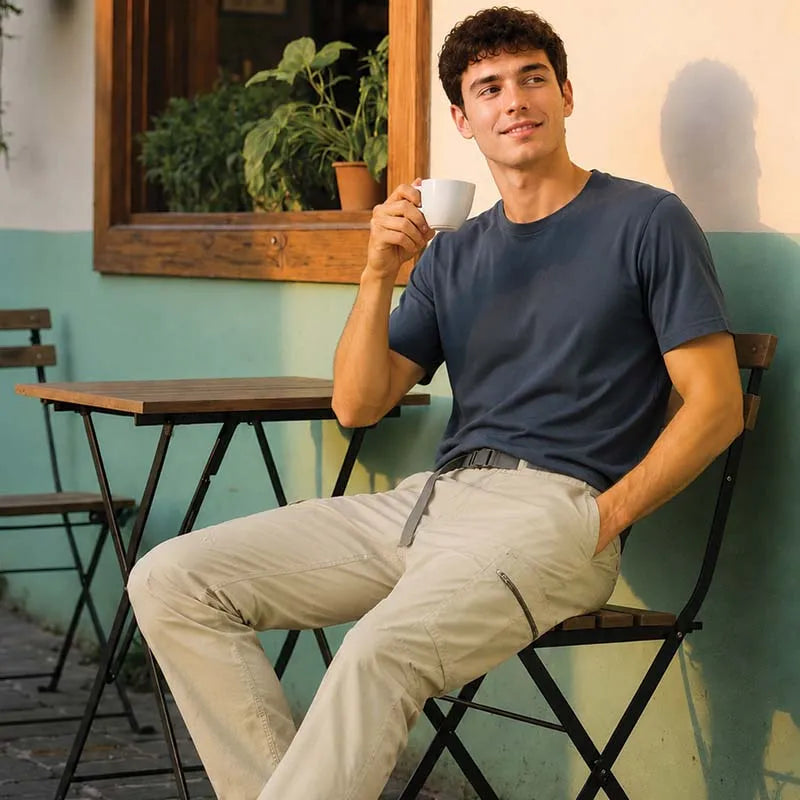
TL;DR:
Convertible (zip-off) trekking pants are worth buying if you trek through big temperature swings in a day, or travel across mixed climates out of one bag. Skip them if your treks are reliably cold (you'll never unzip) or if you want shorts that look good on their own. Most owners rarely fully convert, but the zip still earns its place as a heat vent. Check the zip quality, the fabric, and where the shorts hem lands before you buy.
Every trekking gear list in India mentions convertible pants. Almost none of them tell you when to skip them.
Convertible trekking pants are worth buying if you trek through big temperature swings in a single day, or travel across mixed climates out of one bag. They're not worth it if your treks are consistently cold, or if you'd never actually unzip them. Most owners rarely convert all the way to shorts, but the zip still earns its place as a vent. Your terrain decides this, not the marketing copy.
Convertible trekking pants, also sold as zip-off pants or 2 in 1 hiking pants, are trousers with a zip running around each leg, usually just above the knee. Unzip both and you're wearing shorts. Zip them back and you've got full-length pants again. One garment, two jobs.
The fabric matters more than the zip. It's almost always synthetic: polyamide or nylon, sometimes a polyester blend. Synthetics dry fast, resist snagging, and shed trail dirt in a way cotton simply doesn't. Most pairs add a DWR finish so light rain beads off rather than soaking in, and many carry a UPF rating, useful when you're on an exposed ridge for six hours.
Weight is worth checking before you buy. A mainstream pair runs somewhere around 480 g in a size 34. Light enough that a spare pair on a multi-day trek costs you very little.
Features worth having: zippered pockets, a gusseted crotch, articulated knees.
Here's the thing people miss. Convertible pants are trek pants. Same fabric, same construction, same design intent, with a zip added. So you're not choosing between two different kinds of trousers. You're deciding whether the zip is worth having.
Track pants are a different conversation, and a shorter one. They're usually cotton-heavy, they take forever to dry, and they snag against other layers, which makes layering up on a cold morning genuinely annoying. If you're currently planning to trek in your track pants, read why track pants don't work on a trek before you do anything else.
Big daily temperature swings. This is the classic case and the strongest one. A Himalayan morning starts cold enough that you want full-length fabric. By 11am you're grinding up an exposed south-facing slope and you'd give a lot to be in shorts. One garment covers both.
Multi-climate travel. Airport, city, trail, one pair. If you're packing for a trip where the trek is three days of a two-week itinerary, convertible pants stop you carrying a dedicated trekking wardrobe.
Monsoon treks and stream crossings. Zip off, cross, zip back on. Your legs dry in minutes; soaked fabric doesn't. Worth being clear about what this isn't, though: quick-dry is not waterproof, and no convertible pant will keep you dry in sustained rain.
Packing light. Two garments become one. On a multi-day trek where you're carrying everything, that's real weight and real space.
Sun exposure at altitude. Full-length fabric with a UPF sun-protective rating beats reapplying sunscreen to your legs every two hours. At altitude, UV is harsher than most first-time trekkers expect.
You trek in consistently cold conditions. If you're doing winter Himalayan treks, you will never unzip. You're paying extra for a feature you won't touch, and adding a seam where you don't need one. Buy regular trek pants.
You want shorts that actually look good. This is the most common post-purchase complaint, and it's legitimate. Converted shorts are often too long and cut a bit awkwardly. They're shorts by subtraction, not by design. If you want proper shorts, buy men's cargo shorts and be happier.
The zip is a real failure point. Cheap zips jam and snag when there's dust and sweat involved, which is precisely the moment you need them to work. A zip that needs you to sit down and wrestle with it mid-trail is worse than no zip.
The zip can chafe. A hard zip line running across your thigh, under a loaded pack, on hour seven of a long day. Some people never notice it, some people can't think about anything else. You won't know which you are until you're out there.
Here's what experienced trekkers actually do, and it barely appears in any buying guide.
They don't fully convert. They unzip each leg roughly halfway and leave it there. Hot air escapes through the gap, you get most of the cooling benefit of shorts, and you keep the sun protection and brush protection of full-length pants. No stopping to detach legs. No stuffing zip-off sections into a pack.
This reframes the whole “I never use the shorts” objection. The zip isn't really there to make shorts. It's a vent that happens to also make shorts.
Test it standing up, in the shop. Can you work the zip without sitting down and contorting? On the trail you won't have a bench.
Look at the stitching around the zip line, that's where cheap construction shows first. And check for ankle zips, which let you take the legs off without removing your boots. Plenty of pairs don't have them, and discovering that on a wet morning with muddy laces is a specific kind of misery.
Synthetic over cotton, always. Polyamide and nylon dry fastest.
Stretch is where spec sheets get loud. You'll see 2-way stretch and 4-way stretch quoted as if the number settles the argument. Briefly: 2-way stretches along one axis, 4-way stretches along both. On steep, scrambling terrain, 4-way is more forgiving. But stretch isn't the whole story. A gusseted crotch and articulated knees do at least as much for your actual range of motion as the fabric spec does, and plenty of high-stretch pants move badly because the pattern is wrong. Check how a pair feels in a deep squat. That tells you more than the label.
Look for a DWR finish and a UPF rating if you're heading above the treeline.
Pockets sitting slightly forward on the thigh are easier to reach without twisting under a pack. Zippered pockets for anything you'd hate to lose.
And ask the question most buyers forget: where does the shorts hem land? That single detail causes more disappointment than anything else on this list.
Convertible trekking pants in India run from roughly Rs 1,000 to well over Rs 4,000, and the price tells you less than you'd hope. Here's what actually separates the tiers, and where the money goes.
|
What to check |
Budget pair (under Rs 1,500) |
Premium pair (Rs 3,000+) |
Why it matters on the trail |
|
Zip quality |
Thin coil zips that snag with dust |
Chunky, smooth zips, often YKK-grade |
The zip is the one part that fails. It's the whole point of the garment. |
|
Seams |
Single-stitched, fray at stress points |
Bar-tacked or double-stitched at crotch and pockets |
Seams blow out at the crotch first, usually mid-trek. |
|
Fabric weight |
Goes thin at the knee over time |
Holds thickness season after season |
A pant that thins at the knee is a one-season pant. |
|
Water repellency |
Often none, or washes out fast |
Durable DWR that survives many washes |
Beading rain vs soaking through on a drizzle day. |
|
Ankle zips |
Rarely included |
Usually included |
Remove legs without taking your boots off. |
|
Fit and articulation |
Straight-cut, restricts on steep ground |
Gusseted crotch, articulated knees |
Where the pant actually earns its keep on a scramble. |
The honest read: a budget pair is fine for occasional, fair weather treks where you won't stress the zip or the seams. If you trek often, or in conditions where a blown seam or a failed zip actually matters, the construction on a well made pair is what you're paying for, not the logo. That's the test to apply to any pair, including ours at Eddie Bauer India: if it can't show you better zips, better seams, and fabric that lasts, it hasn't earned the premium.
Here's how that plays out when you line up an Eddie Bauer India pant against what other brands typically offer, from budget to premium. Use it as a checklist against whatever pair you're holding, not as a scorecard.
|
What you get |
Other brands |
Eddie Bauer India |
|
Zip quality |
Ranges from thin coil zips that snag with dust to smooth ones on pricier pairs |
Hard-wearing zips, tested to convert cleanly on the trail |
|
Seams |
Ranges from single-stitched, fraying early, to bar-tacked on better pairs |
Bar-tacked at crotch and pockets, built to last seasons |
|
Fabric |
Ranges from thinning at the knee to holding up over time |
Quick-dry fabric that keeps its weight and shape |
|
Water repellency |
Ranges from none to a durable DWR finish |
DWR finish that survives repeated washes |
|
Sun protection |
Rarely to sometimes UPF-rated |
UPF-rated fabric for exposed, high-altitude trails |
|
Ankle zips |
Rarely to usually included |
Included, remove legs without taking off boots |
|
Warranty & support |
Little to none, or varies by brand |
Backed by returns and brand support in India |
Two honest caveats. “Other brands” spans everything from a Rs 1,000 pair to a Rs 4,000 one, so treat that column as a range across the market, not one specific rival, use it to judge what matters rather than to settle a name vs name argument. And whether an Eddie Bauer pair is right for you still comes down to the same rule as the whole article: if your treks don't need the zip, a simpler pair serves you better.
|
|
Convertible pants |
Regular trek pants |
Trek pants + separate shorts |
|
Adaptability |
Best |
Poor |
Good |
|
Weight carried |
Low |
Lowest |
Highest |
|
Shorts fit and look |
Compromised |
n/a |
Best |
|
Failure points |
The zip |
None |
None |
|
Best for |
Variable conditions, travel |
Cold, stable conditions |
Long trips, comfort priority |
Convertible trekking pants solve one problem well: conditions that change faster than you can change clothes. If that's your trekking, Himalayan altitude swings, monsoon Sahyadris, a trip that runs from city to trail and back, they're worth the money and the zip.
If your treks are reliably cold, or you already own trek pants and shorts you like, skip them. You'd be buying a feature you won't use.
Still deciding? Look at where you actually trek, not where you imagine trekking. If the answer is variable conditions, browse men's convertible trekking pants at Eddie Bauer India, and if it isn't, men's cargo pants for trekking will serve you better for less.
Convertible trekking pants are worth it when your conditions change through the day: cold mornings, hot afternoons, or mixed-climate travel. They're not worth it for consistently cold treks, where you'd never unzip, or if you want shorts that fit well on their own. The zip adds adaptability and one point of failure.
Only if the pair has ankle zips. Many don't, which means sitting down and unlacing. Check before buying, it's a small feature that matters a lot on a wet trail.
Yes, for quick-drying and stream crossings. No, as rain protection. Quick-dry fabric and a DWR finish handle splashes and short showers; sustained monsoon rain needs a separate waterproof layer.
They can, especially under a loaded pack on long days. It varies by person and by where the zip sits. Check the seam finish on the inside of the leg, a well-finished zip line is far less likely to bother you.
Usually the opposite, they're often too long. Converted shorts are a by-product of the design rather than the point of it. If shorts are your priority, buy shorts.
Yes. Women's-specific cuts exist and matter, a men's pair sized down fits badly through the hip. See women's convertible trekking pants.
Convertible pants, without hesitation. Track pants are cotton-heavy, dry slowly, and snag when you layer over them.

Etiam vel magna sed leo feugiat cursus. Cras mollis blandit dolor. Praesent vulputate justo quis volutpat pharetra. Suspendisse


There is nothing in your cart lets add some items.


Subtotal ₹0.00
Shipping Charges Calculated on checkout


